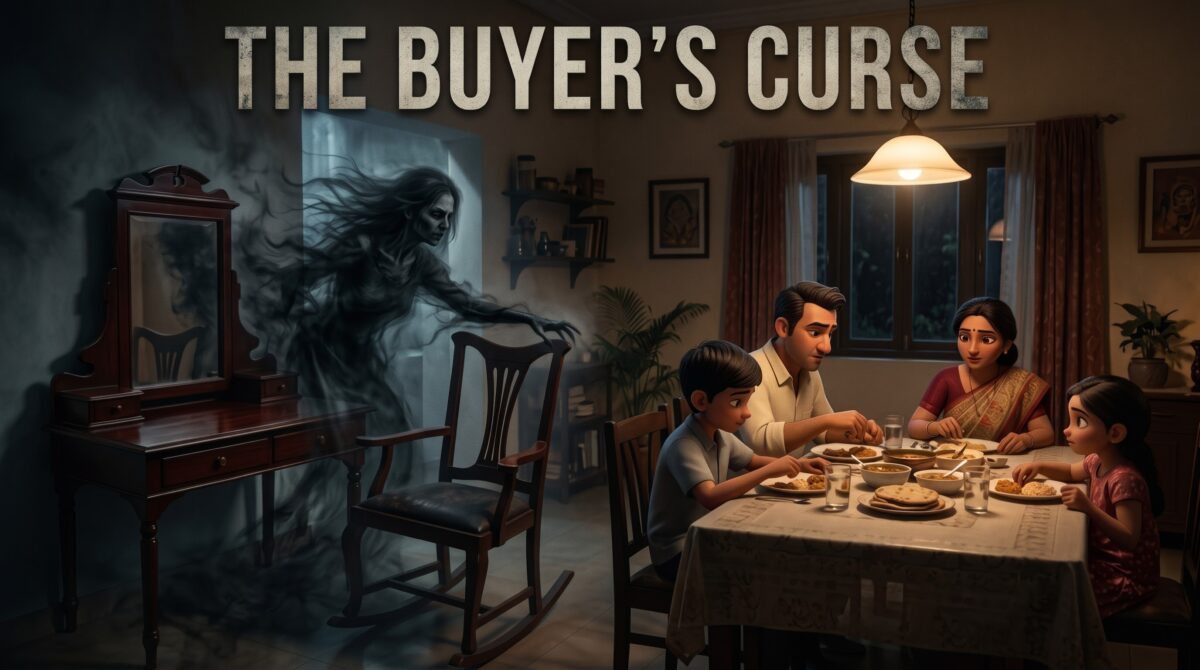
The chair and table sat abandoned in the darkened ruins of the old house for weeks, gathering dust and the whispers of passing wind. Strangers avoided the property, and even stray animals scurried past, unnerved by the lingering sense of dread. But fate has a way of luring the unsuspecting.
One morning, an antique dealer named Mr. Sharma arrived with a battered truck. He was a man in his late fifties with a thick mustache and eyes that had seen enough hardship to make him pragmatic rather than superstitious. Where others saw shadows, he saw opportunity.
The furniture, though scarred with age, held craftsmanship that was unmistakable. The ornate carvings of vines and serpentine figures twisted across the wood in grotesque but strangely beautiful patterns. To Mr. Sharma, they were not frightening, only rare. He pried the chair and table from the dust, loaded them onto his truck, and drove away, humming as if he had just struck gold.
The Restoration
Back at his workshop, Mr. Sharma set to work. He sanded away the grime, revealing a wood so rich and deep it seemed to absorb light. Each night as he polished and restored the furniture, the air grew heavy around him. The workshop would creak as though settling under unseen weight, and sometimes, faintly, he heard the shrieking laughter of a woman echoing through the rafters.
At first, he brushed it off as his imagination. But when his tools began shifting places, and the workshop lights flickered violently whenever he worked on the chair, his confidence faltered.
“Old wood,” he muttered, though the words tasted like lies.
When the furniture was finally restored, it gleamed unnaturally. The carvings seemed alive, writhing as shadows danced across them. Satisfied and eager to rid himself of the pieces, Mr. Sharma placed them in his showroom. It didn’t take long before a buyer arrived.
The New Family
The Mehra family were young and eager homeowners. Rajesh and Sunita, husband and wife, had just moved into a newly built two-story house on the outskirts of town. With them were their two children: eleven year old Aarav, curious and restless, and his younger sister, seven year old Meera, quiet but perceptive.
They wandered into Sharma’s showroom on a Sunday afternoon, their children tugging at their sleeves as they browsed. When Sunita’s eyes fell on the refurbished chair and table, she gasped.
“It’s beautiful,” she whispered, running her hand along the polished surface.
Rajesh hesitated. The carvings unsettled him, but Sunita insisted. By evening, the cursed furniture sat proudly in their dining room.
The First Night
The first night after the furniture’s arrival was unsettling. As the family gathered for dinner, the atmosphere in the dining room grew tense. The lights dimmed inexplicably, and the air grew so cold that their breath misted.
When Meera reached for her glass of water, she froze. “Mama,” she whispered, her small finger pointing toward the wall, “who is that?”
Everyone turned. For a fleeting moment, a woman’s silhouette shimmered in the corner, tall, draped in what looked like tattered fabric, her face obscured. Then it vanished.
A shrill laughter echoed through the house, so piercing that it made the children cry out. Rajesh searched every room, convinced a prankster had slipped inside, but the house was empty.
They tried to brush it off as a strange trick of shadows, but unease lingered.
The Deaths Begin
Aarav was the first to change. The boy who once spent his afternoons playing cricket outside now spent hours sitting in the cursed chair, his eyes fixed on nothing.
“Why don’t you go play?” Rajesh urged one evening.
Aarav only smiled faintly. “She tells me stories,” he murmured.
“Who?”
“The lady in the corner. She laughs funny.”
That night, Aarav didn’t come to bed. When Sunita found him in the morning, he was dead, slumped lifelessly in the chair, his face twisted in terror. His skin was pale, lips blue, and his eyes stared wide at nothing.
As the family wailed in grief, the faint shrieking laughter filled the dining room again, mocking their sorrow.
After Aarav’s death, the house grew unbearable. Footsteps echoed through empty halls. Cold drafts whispered names in the dead of night. Mirrors fogged from within, though the air was dry.
Meera grew withdrawn, often speaking to unseen companions. One night, Sunita woke to the sound of giggling from the dining room. She rushed downstairs and froze.
Meera was spinning in circles, dancing with an invisible figure. The cursed chair rocked back and forth on its own, creaking as though someone sat in it.
“Mama, don’t be mad,” Meera said sweetly, “she wants me to stay with her and Aarav.”
Before Sunita could react, the girl collapsed. Blood trickled from her nose, her tiny body twitching before going still. The house rang once more with that unbearable laughter.
Grief consumed Rajesh. He refused to leave the house, muttering that he had to protect Sunita. But the house had other plans.
One stormy night, Rajesh awoke to the sound of someone calling his name. “Rajesh…” The voice was sweet, seductive, almost familiar. He followed it downstairs, heart pounding.
In the dining room, he saw Sunita standing by the table or at least something that looked like her. Her face was pale, her smile stretched unnaturally wide.
“Come sit,” she whispered, gesturing to the cursed chair.
Compelled, Rajesh sat. The moment he did, his body convulsed violently. His head snapped back, and his chest heaved as though unseen hands were crushing him. Sunita, awakened by his screams, ran in only to see him collapse dead, his eyes bulging in terror.
The chair rocked back and forth, empty.
Alone now, Sunita tried to flee. She called relatives, begged them to take her in, but every attempt to leave the house failed. Whenever she packed her bags, the doors slammed shut on their own. Windows rattled and locked themselves. The cursed furniture seemed to grow heavier with each passing day, as though anchoring her to her fate.
Exhaustion overtook her. One night, she sat trembling at the table, tears streaming down her face. “Why us?” she whispered.
The answer came as laughter… louder, crueler than ever before.
The lights flickered violently. Shadows gathered around her, coalescing into a tall, faceless woman. The figure leaned close, whispering in a guttural hiss: “Stay… with them.”
The next morning, neighbors found the house eerily silent. When police entered, they discovered Sunita slumped across the table, her face frozen in a mask of horror.
The Apparitions Continue
The house was abandoned, but it did not rest. Neighbors reported strange occurrences: lights flickering at odd hours, the sound of children crying, and that bone-chilling woman’s laughter drifting through the night air.
Those brave enough to peek inside claimed to see apparitions seated around the table, the Mehra family, pale and lifeless, eternally bound to the cursed furniture.
The chair rocked on its own. The table bore scratches that hadn’t been there before… deep gouges that spelled out words in a language no one understood.
The curse had claimed another family, but the furniture waited, patient and hungry, for its next victims.
